Lab grown prices have fallen about 8× faster than natural since 2025. Here is what the 2026 data means for retailers and how to answer "will it hold its value?"
"Will it hold its value?" is now one of the most common questions at the jewelry counter. In 2026 the honest answer is different for natural and lab-grown diamonds. Both have repriced since 2021. What separates them is how fast they are, and what sets the price in the first place.
Here is the short version for retailers and wholesalers: what the latest numbers show, what they mean for your stock, and how to explain it to a customer in two sentences.
Both have lost value at very different speeds.
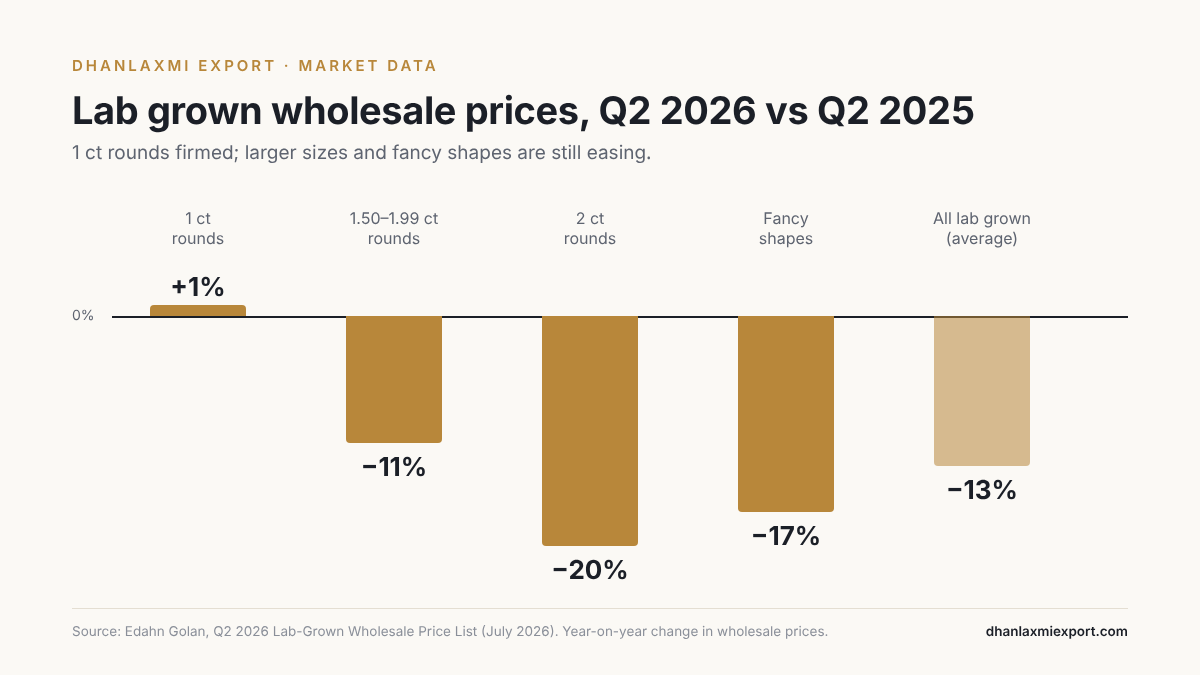
On the same 1.00 ct round benchmark, natural diamond prices are down about 3.5% since March 2025. Lab-grown prices are down about 30% over the same period.
Over the longer run the gap is wider:
Natural: the average 1 ct natural diamond now sells for roughly $3,898, about half its 2021 level. Large, fine stones have held up best. Commercial goods have taken most of the hit.
Lab-grown: the LGD Wholesale Price Index has been down 96% since tracking began in 2018.
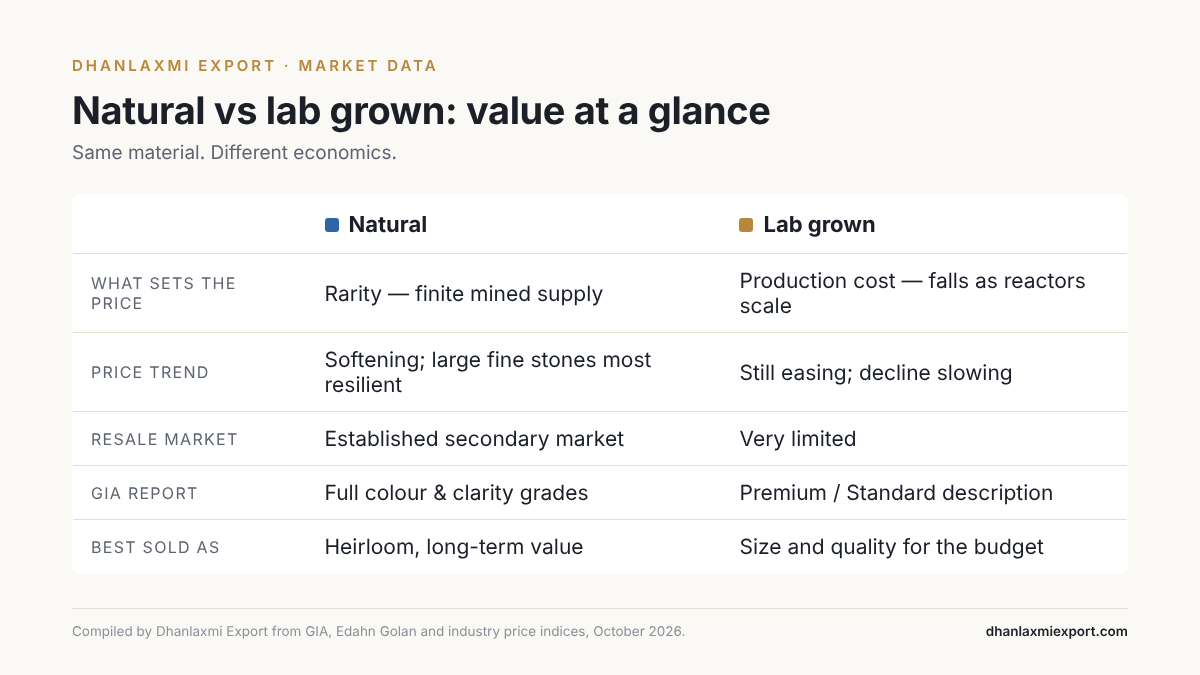
The reason is structural. A natural diamond is priced on a finite supply. A lab-grown diamond is priced at the cost of making it, and that cost keeps falling as production scales.
Lab-grown prices are starting to level out.
The decline is slowing. Wholesale lab-grown prices fell 26% across 2025, then 14% year-on-year in Q1 2026 and 13% in Q2 2026. And not every size is falling.
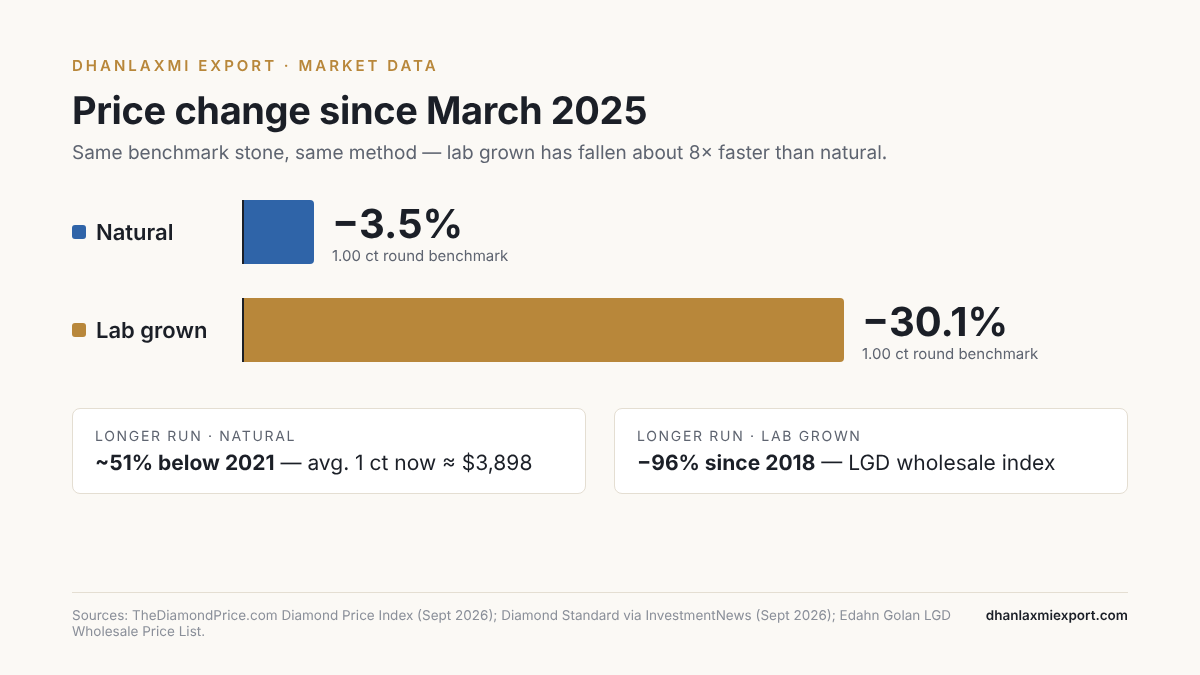
1 ct rounds: up 1% year-on-year
1.50–1.99 ct rounds: down 11%
2 ct rounds: down 20%
Fancy shapes (ovals, pears, marquise, and hearts): down 17% on average
Rough lab-grown prices have also started to rise, which could feed through to polished prices in the coming quarters.
What this means for your inventory
Treat lab-grown as a fashion product with fast turnover, not as a store of value.
Stock lean and reorder often. Larger sizes are still easing, so a big parcel that sits for six months loses value on paper. Buy what you will sell, and restock from a supplier who ships in days.
Watch the margin, not the stone price. Retailers are still achieving a markup of more than 80% over wholesale on lab-grown, and that figure barely moved between 2025 and 2026. A lower cost per stone has not meant a lower margin.
Lead with certification. GIA now describes lab-grown diamonds as premium or standard instead of giving full color and clarity grades. IGI still issues full grades. Make sure every stone you stock carries a report you can verify online.
Sell size and quality, not resale. Lab-grown lets your customer buy a bigger, cleaner diamond for the same budget. That is the honest pitch, and it is a strong one.
How to answer "Will it hold value?"
Keep it to two sentences:
"A natural diamond is priced on rarity, so it keeps more of its value over time, although prices have softened. A lab grown diamond is the same material at a fraction of the price, so you buy it for the look and the size, not as an investment."
Customers trust a seller who says this plainly. Then hand them the certificate.
Quick FAQ
Do lab-grown diamonds have resale value?
Very little. There is no established secondary market for lab-grown diamonds, so sell them as jewelry, not as an investment.
Are natural diamonds still a store of value?
Less than before. Average 1 ct prices are about half their 2021 level, though larger, high-quality stones have held up far better than commercial goods.
Will lab-grown prices keep falling?
The pace is slowing. Annual declines have narrowed from 26% in 2025 to 13% in Q2 2026, and 1 ct rounds have started to firm. Larger sizes and fancy shapes are still easing.
Source lab-grown directly from Surat
Dhanlaxmi Export manufactures IGI- and GIA-certified CVD- and HPHT-grown diamonds from 0.01 to 10 carats at our Katargam unit in Surat, backed by 30+ years of family expertise in the diamond trade.
Real-time trade pricing with no retail markup
Round, brilliant, oval, radiant, and antique cuts
Secure 3–5 day shipping to 40+ countries
Open a trade account at dhanlaxmiexport.com.
Data: Edahn Golan Lab-Grown Wholesale Price List (Q1 and Q2 2026), TheDiamondPrice.com Diamond Price Index (Sept 2026), Diamond Standard, GIA. Figures current as of October 2026.